Out of habit, in both the French and English sense, I have a text. A reading from Daniel:
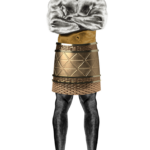
“Then Nebuchadnezzar was so filled with rage against Shadrach, Meshach, and Abednego that his face was distorted. He ordered the furnace heated up seven times more than was customary 20 and ordered some of the strongest guards in his army to bind Shadrach, Meshach, and Abednego and to throw them into the furnace of blazing fire. 21 So the men were bound, still wearing their tunics,[c] their trousers,[d] their hats, and their other garments, and they were thrown into the furnace of blazing fire. 22 Because the king’s command was urgent and the furnace was so overheated, the raging flames killed the men who lifted Shadrach, Meshach, and Abednego. 23 But the three men, Shadrach, Meshach, and Abednego, fell down, bound, into the furnace of blazing fire.
24 Then King Nebuchadnezzar was astonished and rose up quickly. He said to his counselors, “Was it not three men that we threw bound into the fire?” They answered the king, “True, O king.” 25 He replied, “But I see four men unbound, walking in the middle of the fire, and they are not hurt, and the fourth has the appearance of a god.”[e] 26 Nebuchadnezzar then approached the door of the furnace of blazing fire and said, “Shadrach, Meshach, and Abednego, servants of the Most High God, come out! Come here!” So Shadrach, Meshach, and Abednego came out from the fire” (Daniel 3:19 – 26).
The Word of the Lord.
Thanks be to God.
Why should we consider the issue of race and Civil Rights from 66 years ago? While history doesn’t repeat itself, it does rhyme as someone remarked. Race is never separate from the question of American democracy. America struggles once again with issues of race and justice. Events from 1952 to 1965 suggest parallels to 2026. Mississippi in 1954 and Minneapolis in 2026 different but similar.
David Livingston Smith, in Less than Human, argues the words “all men are created equal” raised the question who of counts as a human. His take: dehumanization has done more to create racism and whit supremacy than any other activity. Slaves didn’t count among “those created equal.” America has never fully exorcised the demons of this dilemma.
Michelle Holling and Dreama Moon in a Quarterly Journal of Speech article reminds us “America holds the potential for a national vision premised on rights, freedoms, and democratic participation. At times Americans seem to lose faith in the vision. And without a vision the people perish.
In a local sense, there are two subjects which dominate the life of the South: Religion and Race. Faulkner said you catch Jesus by osmosis in the South. Theologian James Cone felt compelled to write The Cross and the Lynching Tree to make clear how the lynching tree is the exact opposite of the cross.
Issues of race and democracy now embroil us again in furious debates. Historian David Blight warns, ”American democracy is in peril and nearly everyone paying attention is trying to find the best way to say so.”
I am a preacher of the ideals and values of democracy as Walt Whitman is America’s poet of democracy. “O Democracy, for you, for you I am trilling these songs,” wrote our most exuberant democrat.
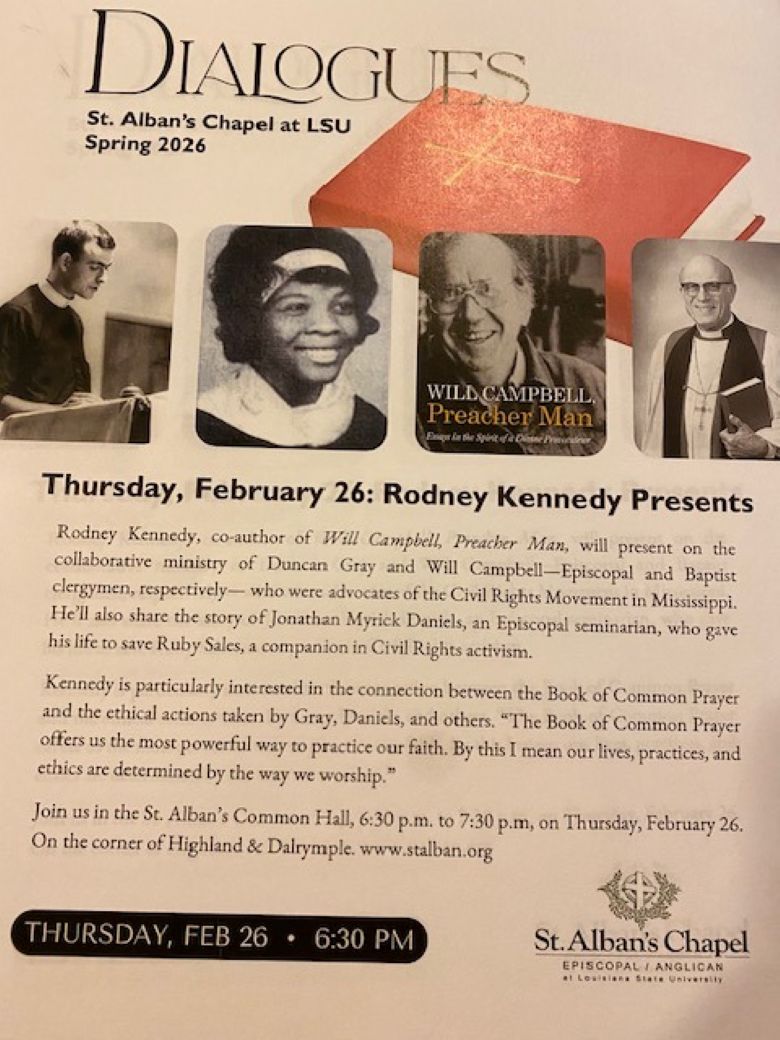
These are the stories of an anabaptist preacher, Will Campbell and an Episcopal priest, Doncan Montgomery Gray, Jr. An odd couple no doubt but the soul of Will was knit with the soul of Duncan, and Will loved him as his own soul.
I tell these stories because I am both an Anabaptist and an Episcopalian. For years I called myself a catholic baptist. One day, my priest at the time, Father Ralph Howe told me a catholic baptist was merely an Episcopalism. Johnelle and I were confirmed at Trinity Episcopal Church. She told Ralph one day she always felt a bit empty in the Baptist service without communion. Ralph told her, “Johnelle you have always been a closet Episcopalian.” The bishop presiding at our Confirmation said, “We welcome those of you who were Baptists and remind you of one Baptist practice you should continue, tithing.”
I am delighted to be an Episcopalian. What attracted me was the liturgy, the Book of Common Prayer and the weekly observance of the Sacrament of Holy Communion. One day it dawned on me, Jesus didn’t say “This is like my body.” The baptists have communion once every 3 months and that makes a person really hungry. And in the Baptist church when the sermons were dreadful and the preacher droned on till judgment day; there was no wine to wash away the agony.
I find the writing and publication of the Book of Common Prayer by the Archbishop of Canterbury, Thomas Cramner and his contributors in 1549 and 1552 to be the most important book published with possibly only the King James Version of the Bible (1611) being its superior.
James Baldwin wrote, “History does not refer merely to the past …. History is literally present in all we do.” William Faulkner said, “The past is never dead. It’s not even past.”
A Pair of Dissenters
Rhetorically, Campbell and Gray were dissenters. Campbell left the church and Gray remained a faithful churchman, but both were dissenters. Robert L. Ivie, professor emeritus Indiana University and rhetorical scholar, in “Enabling Democratic Dissent,” argues, “Dissent is a key word in the vocabulary of a democratic people , , , , and an antidote to political repression” (Robert L. Ivie, “Enabling Democratic Dissent,” Quarterly Journal of Speech, Feb 2015, 46). [Dr. Andy King was editor of this journal from 1998 – 2001]. Dissent is different from protest. Dissent doesn’t seek the spotlight, doesn’t do its best work in the streets with slogans, signs, and shouts.
Neither Gray nor Campbell started out as dissenters. Vaclav Havel, an expert in dissent, says, “In fact, of course, they do not usually discover they are ‘dissidents’ until long after they have actually become one, ‘Dissent’ springs from motivations far different from the desire for titles or fame. In short, they do not decide to become ‘dissidents’, and even if they were to devote twenty-four hours a day to it, it would still not be a profession, but primarily an existential attitude” (Vaclav Havel, The Power of the Powerless, 59).
WILL CAMPBELL
A preacher has a text and a professor has a textbook: Will Campbell, And Also With You, is my textbook.
I love And Also With You and think that in many ways it is Campbell’s best book. Baptists don’t usually write about Episcopal priests. Campbell was drawn to Duncan Gray because Gray was just a “good man.” Will asks what the mark of a good man is. Scanning the Book of Common Prayer, he observes how often the words joy and joyous appear, and that those were the same words many used to describe Gray. Will observes, “A good man, I concluded, will be a man of unceasing joy. Joy in the biblical and Prayer Book understanding. Not joy as happy-go-lucky for he is capable of deep sadness. Over the years, through trials and tribulations, good times and bad, victories and defeats: joyous. Springing from assuredness that God has intervened in human history. Advent. Easter. Pentecost.
A person close to Gray had said, ‘Duncan is what the Episcopal Church would be if everyone in it believed (lived by) the words they repeat every Sunday.’ The radicalism of the liturgy had made an ordinary man good. Joyous. And a truly joyous person is never up to anything” (245).
Father Brandon had a sermon recently about blessing and being blessed. Campbell and Gray were a blessing to many and are among the blessed of the Lord.
Campbell graduated from Louisiana Baptist College, Pineville, LA, Wake Forest University and Yale Divinity School. He was called to be the pastor of a Baptist church in Taylor. LA. Campbell recalled his congregation as “good people” who liked him well enough, tolerated his views and put up with him.
He walked the picket line with union members at the paper mill in Elizabeth. He preached against racial discrimination and Joe McCarthy’s “red scare,” visited Grambling University and paying the family maid minimum wage.
Around town his church members said, “You wouldn’t believe our little preacher, he is the cutest thing. He talks about our kids going to school with niggers. He is a card, you know. We love him and don’t pay any attention to him. We don’t believe all that.” They were proud to have one of the one three Yale-trained pastors in the state of Louisiana (Will D. Campbell and Richard C. Goode, Crashing the Idols, 9 – 10).
In 1954, he took a position as director of religious life at the University of Mississippi, only to resign in 1956. This was in part due to the hostility—including death threats—he received for supporting racial integration. Gray came to Oxford in 1960.
Campbell then became a field officer for the National Council of Churches. Here he managed to offend the liberals and he resigned. Here ends Campbell’s employment in the church and church related jobs.
He became, in his words, “the writer of rare books” due to low sales.
Campbell had a strong definition of Christianity: “We are all bastards and God loves us anyway.”
Jonathan Daniels was a friend of Will Campbell’s. He was a student at the Episcopal Theological Seminary in Cambridge, Mass. He worked in black voter-registration in Lowndes County, Alabama. He is a martyr and appears in Holy Women, Holy Men.
Daniels, a Catholic priest from Chicago and two Black students were arrested and held for a few days in the county jail at Hayneville. Released, they stopped at a small grocery store on the edge of town to purchase Cokes. In the South all soft drinks were called Cokes. The owner of the store, alarmed at the mixed group, telephoned a special deputy named Thomas Coleman. Coleman pulled up at Daniel and his friends were leaving the store. He opened fire with a shotgun. Daniel, protecting one of the students, named Ruby Sales, fell dead at the first shot. Coleman then killed the Catholic priest.
Though arrested for the murder of Daniels, Coleman, an alleged member of the Ku Klux Klan, was acquitted six weeks later by an all-white jury. He said he felt threatened. Daniels had a Coca Cola in his hand. Imagine killing unarmed American citizens in the street. Those were dark days, huh?
P. D. East pressed Campbell on his definition of Christianity. “Tell me, which one of those bastards did God love the most?”
Campbell says this was a moment of repentance for him. He had denied his roots, his people. He had spent 20 years worshiping at shrines of enlightenment and academia. He had denied his faith and his history and his people. It dawned on him, “My people were the Thomas Colemans, too, with their shotguns. Loved by God. And if loved, forgiven, and if forgiven, reconciled.”
Saint Duncan Gray: Four Times into the Fiery Furnace
Lord have mercy. Shadrach, Meshach, and Abednego only endured the fiery furnace one time. Gray at least four trips into the abyss.
If I were somehow allowed to chair the committee at General Convention responsible for adding to the list of Holy Women, Holy Men, I would nominate Duncan Gray, Jr. As Campbell puts it, Gray “was a significant player in the drama of 20th century history.”
Both men would have a conniption fit over talk of sainthood. When seminary students came to Campbell’s farm outside Nashville asking to be disciples, he would chase them away. “I’m not looking for any damn disciples. Go follow Jesus.”
Gray didn’t like attention on himself and asked to be called Mr. Gray rather than Father. The humility was genuine.
The anabaptist theologian from Shreveport, James McClendron taught me to do theology biographically. In Biography as Theology, he argues “the truth of faith is made good in the living of it or not at all.”
McClendon says, “In or near the community there appear from time to time singular or striking lives, the lives of persons who embody the convictions of the community, but in a new way; who share the vision of the community, but with new scope or power, who exhibit the style of the community, but with significant differences. When such a person or persons appear, they shine a light in the darkness. They correct or reshape or enlarge the community’s moral vision. They arouse the impotent wills within the community to make it a faithful communion of the saints” (Quoted in L. Gregory Jones, “Embodying Scripture in the Community of Faith,” in The Art of Reading Scripture).
Duncan Gray was one of those rare Christians who knew the church needed protecting from the powers and the principalities. The church needs some saints – people who seem powerless by the world’s standards. Only God produces saints. Those who try to be saints end up like priests always campaigning to be bishop, without enough votes to get out of committee..
Duncan Gray was no Luke Skywalker. He was a faithful priest of the church. He was not a social activist; he was a man possessed by the Bible and The Book of Common Prayer. The words spoke like thunder from Sinai to Gray.
He was a man living his calling every day in the attempt to honor his ordination vows. “Will you be ready, with all faithful dialogue, to banish and drive away from the Church all erroneous and strange doctrines contrary to God’s Word; and to use both public and private monitions and exhortations?” He answered, “I will” each step of the way.
Gray didn’t choose for his life to be overshadowed by the fiery furnaces of America’s racism. The winds in Mississippi blew the flames in that direction. Some of Gray’s friends called him Joe Btfsk, the little man of Lil’ Abner fame who always had a dark cloud of adversity hovering over him., following him wherever he went.
In seminary on “The Mountain,” University of the South School of Theology, Gray faced the crisis of whether Black students would be admitted. He was president of the Student council his senior year and had to face his beloved Uncle, the president of the school, with the issue. His uncle opposed the admission of Black students and would later oppose the admission of women.
The battle on the mountain led all but one member of the faculty to resign. At the time, the proponents of admitting Black students didn’t realize there was no canon prohibiting the admission of Blacks. There was one against admitting women and it would be wielded as a sword in that later fight.
Very few seminarians receive the baptism of fire preparing them for a ministry of fires constantly breaking out, but Gray did.
After graduation, his first parish was in the Delta in Cleveland and Rosedale, MS on the eve of the Supreme Court decision, Brown vs. the Board of Education. Gray was a member of the department of Christian social relations of the Episcopal Diocese of Mississippi, a little known department not known for troubling the waters. This was about to change.
Gray was drawn back into the fiery furnace of race for a second time. Gray wrote the document, “The Church Considers the Supreme Court Decision,” 3,000 words that would rock the diocese. Gray basically added to the words, “Thus saith the Law,” the affirmation, “Thus saith the Lord.”
Many considered the document blasphemy and heresy. The document was reprinted in the diocesan paper, The Church News, published as a pamphlet, but the publisher wouldn’t put his stamp on it out of fear of reprisals. Gray mailed a copy to every member of the Mississippi legislature. A spunky priest!
The battle on the mountain at Sewanee has been a baptism of fire, an initial invasion. Gray was prepared for his second tossing into the fiery furnace. Unlike Shadrach, Meshach, and Abednego, Gray would be thrown repeatedly into the same flames. And each time a fourth figure came alongside and so Gray did not faint nor grow weary of the battle. He was a priest of the Church of his people. And of his Lord.
The Fourth Fiery Furnace
I will return shortly to the third and most significant fiery furnace.
When he came to St. Paul’s Church in Meridian, he faced the fierce resistance of the White Citizen’s Council and the presence of the KKK. It seemed there were charred houses of worship, dynamited dwellings, and dead bodies littered everywhere.
A year before Gray arrived in Meridian one of the most heinous crimes of the civil rights era was committed nearby.. Three young men, James Chaney, Michael Schwerner and Andrew Goodman were murdered. The FBI came. The bodies were found in the levee of a pond and Neshoba County deputies were involved in the killings. Perhaps you have seen the movie, Mississippi Burning starring Gene Hackman and William Dahoe.
If Gray had hidden in a cave like Elijah at some point, we would have understood. But he faced the challenge with courage, a gentle and kind spirit.
The Third Fiery Furnace
September 30, 1962, James Meredith was brought to the campus of Ole Miss on this Sunday night. He would be the first African American ever admitted to the University of Mississippi. The night erupted into a battlefield.
Gray openly and aggressively advocated the integration of the races – an abomination for most white Mississippians in 1962.
This one Sunday night encapsulates Duncan’s career. He was 36 and was clinging precariously to the side of the Confederate monument at the entrance to Ole Miss. He was trying to address the mob gathered there but was drowned out by cries of “Kill him, kill him, kill him!” Not exactly, “Nice sermon rector!”
A Confederate monument may seem an unlikely launching pad for becoming an Episcopal bishop, but in the moment Gray’s life hung in the balance. He came as close to being murdered for his faith as is possible.
The mob was in no mood to listen to an Episcopal priest.
“I’ll bet he belongs to the National Council of Churches.”
“Traitor! Traitor! Let me at the scalawag!”
The anger was aimed directly at Mr. Gray. The night would be a crucible testing every ounce of Gray’s faith.
Two men were perched on the Confederate statute: Duncan Gray and General Walker.
I love the conversation Will reports between Gray and General Walker, the retired general from Texas who had come to aid those protesting James Meredith’s entrance to the University of Mississippi. Gray is pleading with the general to use his influence to stop the riot, but instead Will reports that Walker turned on the priest and demanded, “Just who the hell are you anyway? And what are you doing here?” “My name is Duncan Gray. I am the rector of the local Episcopal Church,” the priest replied. “This is my home and I am deeply hurt to see what is happening to the university and the state. I am here to do anything I can to stop the rioting and keep any more people from getting hurt or killed.” The general became even more angry, moving toward Mr. Gray and exclaiming, “You’re the kind of minister that makes me ashamed to be an Episcopalian!” Mr. Gray, realizing that he was on the verge of losing his temper, tried to remain calm, explaining that he was on home ground. “I have a proper concern and interest in keeping law and order. You, sir, are a Texan and have no business here. Your very presence here is making matters far worse. You should have stayed in Texas. We have enough problems of our own.”
General Walker was a Texan and as any native Louisianan will tell you, Texas is not a southern state. It is another whole country and by and large, we are not fond of Texas even though entire subdivisions in Houston are made up of people from Louisiana. Maybe God did make Texas to give angels a place to dance, and maybe we shouldn’t mess with Texas, but we don’t like Texas.
As the mob grew more violent, Gray was grabbed from the monument and thrown to the ground. Two large men had Gray penned to the ground. He is about to face death.
“No, no, no,” one kept saying. “Let’s not hurt the preacher.”
“You heard what he said on TV. Let’s kill the sob.”
“I know, I know, I know. But he’s a preacher. He really believes that stuff.”
Evans Harrington, an English professor, and a few others came to Gray’s defense. One believes again in miracles when English and rhetoric professors brave a howling mob like King Arthur’s knights of the Round Table. Somehow they got Gray away from the mob.
The group took refuge in the Y Building. After calling his wife to assure her he was all right, Gray made his way back outside to ask those he met to put down the bricks, bottles, and other weapons they held. Some did.
I can only report with regret that Louisiana was represented at the battle. A rickety old school bus, with Louisiana plates parked behind Hemenway Stadium. Five burly men emerged from the bus singing “The Cajun Ku Klux Klan, one carrying a beer cooler, another picnic supplies as if they were there to have a tailgate party before the LSU Tiger whipped the Rebels. They claimed they had machine guns and one of them said, “Ah’m gone tole you, my frien, we’re looking fo du action.”
Federal troops finally arrived. The local National Guard unit, Troop E commanded by one of Gray’s parishioners, Captain Murry Falkner, nephew of William Faulkner. Captain Falkner was a ardent segregationist and vocal critic of his rector’s sermonizing. But this night he did his duty. They roared over the bridge into a hail of bricks, planks, bottles and bullets.
Captain Falkner and his troops stopped the mob from lynching James Merideth .
The registration of James Meredith at eight o’clock the next morning, after the riot was not the end of the crisis for the university, James Meredisth or Duncan Gray, Jr. It was only the beginning.
May the Lord be with y’all. And also with you.
www.theprogressivepreacher.com
Selected Bibliography
Primary Sources
The Book of Common Prayer, 1982.
The Holy Bible, New Revised Standard Version.
Campbell, Will D. And Also with You. Franklin Tennessee: Providence House. 1997.
Campbell, Will D. and Goode, Richard C. Crashing the Idols: The Vocation of Will D. Campbell (and any other Christians for that matter). Eugene, Oregon: Cascade Books. 2010.
Holy Women, Holy Men: Celebrating the Saints. New York: Church Publishing, 2009.
Additional Sources
Autry, James A. Nights Under a Tin Roof.
Baldwin, “Unnamable Objects, Unspeakable Crimes.”
Blight, David W. Race and Reunion: The Civil War in American Memory.
Childress, Kyle and Kennedy, Rodney. Will Campbell, Preacher Man: Essays in the Spirit of a Divine Provocateur.
Cone, James. The Cross and the Lynching Tree.
Connelly, Thomas L. Will Campbell and the Soul of the South.
Faulkner, William. Requiem for a Nun.
Hauerwas, Stanley. Unleashing the Scripture: Freeing the Bible from Captivity to America.
Havel, Vaclav. The Power of the Powerless
Holling, M. A., & Moon, D. G. (2021). 20/20 in 2020?: Refractive vision, 45, and white supremacy. Quarterly Journal of Speech, 107(4), 435-442.
Ivie, Robert L. “Enabling Democratic Dissent,” Quarterly Journal of Speech, Feb 2015. 46 – 59.
McClendon, James. Biography as Theology.
Smith, David Livingstone. Less than Human: Why We Demean, Enslave, and Exterminate Others. Macmillan+ ORM, 2011.