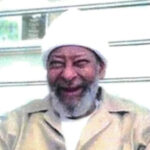
(The day after this article appeared in Baptist News, the governor of Alabama commuted the death penalty of Sonny Burton)
The state of Alabama is scheduled to execute Sonny Burton on March 12. An execution in Alabama is not unusual. Since 2016, the state has executed 73 people. Gov. Kay Ivey has granted clemency one time in almost 10 years in office.
However, even the fiercest supporters of capital punishment might take offense at the execution of Sonny Burton. He didn’t kill anyone.
Consider the facts of his case. In 1991, Burton accompanied Derrick DeBruce and four other men to an AutoZone store in Talladega. He carried a gun. He was guilty of armed robbery. Then, Burton left the store. DeBruce stayed behind and killed a man.
DeBruce was convicted of murder and sentenced to death. Burton also was convicted of murder and was sentenced under a state law that permits accomplices to receive the death penalty if a murder happens during the course of another felony, like a robbery.
“Burton is now facing death while the murderer has received a lesser sentence.”
In the legal machinations of Alabama, DeBruce appealed and received a life sentence without parole. Burton is now facing death while the murderer has received a lesser sentence.
On what planet can this be seen as justice? Is the law of Alabama more sacred than the rights of Burton? Even the conditional vengeance of “an eye for an eye” from ancient Hebrew culture would exonerate Burton from death.
Sonny Burton
Attempting to understand requires an understanding of the South. The Southern states execute the most people. Texas leads the list with 586 executions since 1976, followed at a distance by Oklahoma with 124 in the same period. Florida, Virginia, Missouri, Georgia, North Carolina and Arkansas are Southern states in the Top 10 as well. Only Ohio and Arizona lie outside the South and yet make the list.
“Violence appears intrinsic to the Southern soul,” argues historian Thomas L. Connelly Images of violence crowd the Southern photo album. Andrew Jackson destroying the Creek Indian nation at Horseshoe Bend; the dueling code in Antebellum Louisiana; Gen. Nathan Bedford Forest leading white-robed comrades of the KKK; Appalachian Mountain feuds; the Harlan, Ky., labor wars; the Scottsboro boys and the murders in Hayneville, Ala., and Neshoba County, Mississippi.
Perhaps our deepest connection to violence remains the quasi-legal executions of the lynching era. James H. Cone says in The Cross and the Lynching Tree, “Lynching was an extralegal punishment sanctioned by the community.”
Nearly 5,000 people were lynched during the lynching era of America (1880 to 1940). The prevailing public attitude about lynching allowed Theodore Bilbo to campaign for the Senate in the 1930s as someone who would endorse lynching Black people to keep them from voting.
Daily newspapers publicized hangings and lynchings. Preachers, church choirs, good Christians and the curious gathered to witness a lynching against the backdrop of “Shall We Gather at the River?”
Southerners are predisposed to the violence of capital punishment. But they didn’t learn the ideology from Jesus. The lynching tree has a contrapuntal — the Cross of Jesus. Visions of Black bodies dangling from the trees can’t escape the scene of Jesus hanging from the Cross. Acts 10:39 remains as testimony: “They put him to death by hanging him on a tree.”
In “Christ Recrucified,” Countee Cullen lamented, “The South is crucifying Christ again” as he gazed at another lynching (1922).
“Southern notions of law and order, justice and God’s vengeance still color attitudes toward capital punishment.”
Cone saw clearly the connection between the Cross and the lynching tree. He wrote, “Until we can see the cross and the lynching tree together, until we can identify Christ with a ‘recrucified’ black body hanging from a lynching tree, there can be no genuine understanding of Christian identity in America, and no deliverance from the brutal legacy of slavery and white supremacy.”
Southern notions of law and order, justice and God’s vengeance still color attitudes toward capital punishment. Treating Romans 13:4 as if it were the Eleventh Commandment, literally applied, seems to demand capital punishment. “If you do what is wrong, you should be afraid, for the authority does not bear the sword in vain! It is the agent of God to execute wrath on the wrongdoer.”
Coupled with Romans 13:4 is a long-standing agreement with “an eye for an eye and a tooth for a tooth.” These Scripture verses still breathe life into support of capital punishment.
Robert Jeffress calls it “the godly principle.” He argues, “God gives government the power of the sword, of capital punishment, of executing wrong doers.” It’s as if “You shall not kill” has been abrogated by a bad reading of Romans 13:4 and clinging to a literal reading of Exodus 21:23–25.
The combination of Southern propensity for violence and vengeance coupled with strident interpretations of Scripture mandating “no mercy” is fully on display in Burton’s case. Everyone agrees: Burton did not kill anyone.
Several jurors from Burton’s trial have said they do not want him to be killed. Tori Battle, the daughter of Doug Battle — the man who was killed at the AutoZone — also doesn’t want the state to execute him.
Most importantly, there is a Christian argument for mercy. Stanley Hauerwas argues, “The Christian objection to capital punishment is not that it is cruel and inhumane, but because all human sacrifice has been ended through Christ’s cross.”
The church has a stake in limiting the state’s power to punish. When we lift up the bread and say, “This is my body,” and the cup with, “This is my blood,” we remind the world that the Eucharist is a politics not of this world.
Justice should be tempered with mercy. Gov. Ivey can cast one vote for mercy in a region tool long known for inhumanity to humankind. She has the power to offer mercy.
God has mercy. May the governor follow God’s example.