







The Sermon on the Mount: Christian Constitution
Matthew 5:1-12
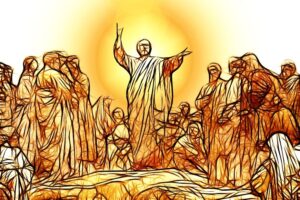
Image thanks to geralt
The gospel reading for Sunday overwhelms us. Jesus begins his sermon with a list of practices not a bill of rights. Here is our Christian constitution. We agree that we will not kill one another.
Gene Davenport, in his book, Into the Darkness says, “When the first hearers of Matthew’s Gospel heard Jesus’ call to suffer rather than to inflict suffering, to accept death rather than to inflict death, to reject all efforts to save themselves from their plight by military action and to leave their deliverance to God, they knew that the one who gave such scandalous instruction had himself lived and died in accord with that call.”
The Sermon on the Mount is to be lived in full by the followers of Jesus. The sermon maps a theology of nonviolence. You should not be allowed to read and claim the Sermon on the Mount if you are supporting violence and killing by ICE and Border Patrol agents. The Sermon also teaches us to trust one another and in our current state of a “culture of lies,” we are unable to faithfully read the Sermon.
How can we cram the Beatitudes into one sermon? We need a month of Sundays to handle this task. Every statement of Jesus cries out for sermonic development. Stanley Hauerwas attempts the task in his sermon entitled, “A Sermon on the Sermon on the Mount.”
How far into the Beatitudes can you read without choking? Blessed are the poor in spirit and yet we are arrogant, proud, and gleeful over people being shot in the street. How can we rightly mourn if we aren’t sorry for people killed? How can be preach meekness when we are filled with the antagonisms and prejudices of our own side in this fight? How can we hunger and thirst for righteousness when we insist we are right and we hunger and thirst for political power? How can we be merciful when so many Americans are unmerciful toward one another? How can we be pure in heart when we peddle lies so huge and damaging? How can we claim to be peacemakers when we are hurling venom at one another, inciting outrage, and advocating for civil war?
In my lifetime as a preacher, it has seemed any preacher worth his or her salt needed to write a book on the beatitudes. And in this plethora of sermonic wisdom, nothing has seemed less authentic to the Sermon on the Mount than translating “blessed” as “happy.” The sermon is hard, hard as nails, hardwood, crosses. Happy doesn’t go well with hard. And our culture has definitions for “happy” unrelated to the biblical meaning of “blessed.”
Will Campbell reflecting on a man leaving his wife because “you don’t make be happy,” is skeptical. He says, “I have no idea what that means. Happiness is a deceptive, illusory, and elusive thing …. A fugitive one never finds by pursuing.” He reminds us “happiness” is not in the wedding vows: For better or worse. In sickness and in health. To love and to cherish. Till death do us part. “But nothing about happiness. That is simply not part of the contract.”
I can’t equate the Beatitudes with our usual definitions of “happiness.” I am sticking with “blessed.”
Unless we are a people formed by the practice of agreeing not to kill one another, we can’t rightly read the Sermon on the Mount. I think the main reason many American Christians are more attracted to the Ten Commandments rather than the Sermon on the Mount is the belief they can come closer to living up to the laws of the Ten Commandments.
The Sermon on the Mount leaves us gasping for reasons not to live by its teachings. Biblical literalists will say, “The Sermon on the Mount is not meant to be taken literally.” Others claim the demands of the sermon are only for the select few, the religious, the celibate, the priest, and so forth.
The medieval world, for example, divided people into “secular” and “sacred.” The secular people – the butcher, the candlestick maker, and the baker lived by a less strenuous code. The sacred people – the priests – pursued a holiness beyond that of ordinary people.
Still others argue the sermon presents an impossibly high ideal whose purpose is to make us aware of our sinfulness. In this reading, the sermon doesn’t tell us how to live and what to do but reminds us that Christian moral life is only about love.
Do you ever despair of “explaining” what Scripture doesn’t mean? Let’s face it: The sermon is meant to be lived. Ironically, this opens me to the charge of being a legalist. I can almost laugh at a literalist explaining that I am a legalist because I believe the Sermon on the Mount is meant to be lived in our daily lives.
I am also convinced the Sermon on the Mount gets kicked around as non-essential because living it is so hard. Odd isn’t it that a people called into existence by a suffering and sacrificing Savior would shy away from hardness? The disciple of St. Paul, who most likely wrote 2 Timothy, understood and embraced the hardness of the Christian life. You then, my child, be strong in the grace that is in Christ Jesus, and what you have heard from me through many witnesses entrust to faithful people who will be able to teach others as well. Share in suffering like a good soldier of Christ Jesus. No one serving in the army gets entangled in everyday affairs; the soldier’s aim is to please the enlisting officer. And in the case of an athlete, no one is crowned without competing according to the rules. It is the farmer who does the work who ought to have the first share of the crops. Think over what I say, for the Lord will give you understanding in all things.
Dietrich Bonhoeffer understood as his Cost of Discipleship makes clear. Living the Sermon is hard not impossible.
Sometimes I think we don’t mind following Jesus as long as he doesn’t lead us where we don’t wish to go.
But Jesus insists on taking us where we don’t wish to go. In our current political malaise, the politics of Jesus in the Sermon on the Mount takes us places we are not prepared to go.
Who among us is willing to put down our weaponized rhetoric to become “poor in spirit”? Or become “meek,” “merciful,” “peacemakers”?
And if we manage to survive the gauntlet of the beatitudes, who among us is ready to turn the other cheek, give your shirt and your coat as well and go also the second mile?
By now, we are exhausted at what amounts to a call to repentance? Who among us will consent to love our enemies? When James Meredith was shot, only Will Campbell went to pray with the man who shot Meredith.
Hundreds of clergy as taking part in the peaceful protests in Minneapolis. I believe they are living the Sermon on the Mount. Nonviolence is the only key that unlocks the treasure that is the Sermon on the Mount. After all, the message of the Sermon is the man named Jesus. The message and the man are the same.
Are we ready to live the sermon rather than justify our excuses? Sermon